Costosternal Anatomy
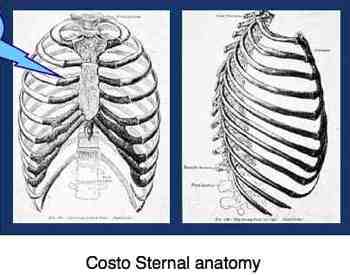
The costo-sternal anatomy makes up the thoracic wall. It encases the lungs, the heart and the great vessels.
This area is unique in the body, and quite different to the other bones and joints. This is because of its important function of protecting the vital organs, whilst still enabling breathing. The ribs make up an essential part of the thoracic wall.
The rib-cage is formed by three sets of bones:
- The sternum, or breastbone, in front.
- It connects via twelve pairs of ribs to
- twelve thoracic vertebrae posteriorly.
The joints between the breastbone and the ribs are made up of special
so-called costal cartilage which may sometimes become subject to a very painful condition called Tietze's syndrome; see more later.
Note the costal cartilages arrowed in blue below.
They can also be injured by trauma, for example, falling on your fist whilst skating, or hitting the steering wheel during a head-on collision. Always use a safety belt.
This page was last updated by Dr Barrie Lewis on 7th July, 2019.
Costosternal Anatomy
Muscles
From the chiropractic perspective, costosternal anatomy is concerned with bones, muscles, joints and nerves. Of course there are also arteries ...
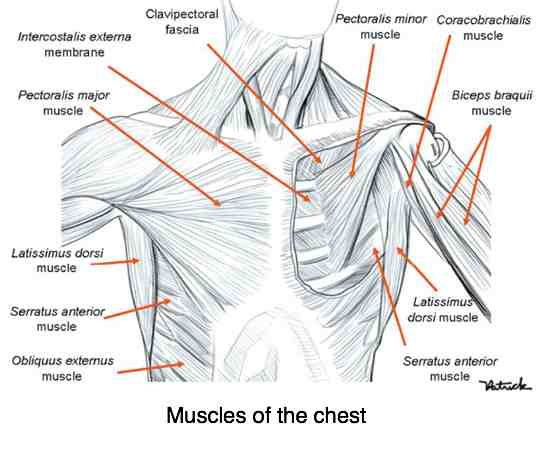
The spaces between the ribs are filled by the INTERCOSTAL MUSCLES. These muscles extends from the sternum to the angle of the rib, posteriorly. They are very important in breathing.
The PECTORALIS MAJOR muscle is can be seen on the anterior thoracic wall. It has two origins, one of which is the sternocostal cartilages and the other the sternum bone.
The PECTORALIS MINOR muscle is located at a deeper level than the pectoralis major muscle. It originates from the third, fourth and fifth ribs and is inserted in the coracoid process of the scapula.
The SERRATUS ANTERIOR muscle covers most of the lateral thoracic wall and originates from the first nine ribs. Its fibers converge posteriorly to be inserted into the medial margin of the scapula, thus contributing towards forming the medial wall of the axilla.
The diminutive SUBCLAVIUS muscle originates from the first rib, close to the chondrocostal junction, to be inserted in the collarbone. Its function is to stabilize the clavicle in movements of the shoulder.
The SERRATUS ANTERIOR muscle covers most of the lateral thoracic wall and originates from the first nine ribs. Its fibers converge posteriorly to be inserted into the medial margin of the scapula, thus contributing towards forming the medial wall of the axilla.
The diminutive SUBCLAVIUS muscle originates from the first rib, close to the chondrocostal junction, to be inserted in the collarbone. Its function is to stabilize the clavicle in movements of the shoulder.
Tietze's syndrome
Breastbone pain can be very severe.
Costo sternal joints: Breastbone Pain
These costosternal anatomy joints, when subluxated, are a common cause of chest pain.
Chiropractic treatment involves stretching the doctor's hands right around the ribcage, from the sternum to the spine, an providing gentle thrusts to release the fixations.
The rib forms three synovial facet articulations with the spine.
- One with the TP, the costo-transverse joint, and
- Two with the spinal bodies above and below the rib, the costo-vertebral joints.
This arrangement restrains the motion of the ribs allowing them to work in a parallel fashion during breathing.
If a rib had only one joint posteriorly, the resultant swivel action would allow it to move out of synchronization with respect to its neighbours, making for a very inefficient respiratory mechanism.
These joints may be sprained, often after a violent sneeze, causing severe sharp pain with every breath. The condition responds extremely well to a gentle chiropractic adjustment.
Treatment for costochondritis is just standard, but modified chiropractic help.
Understanding rib pain causes is important.
Bats in my Belfry

If you love to read, you will probably enjoy batty chiropractor Bernard Preston's latest book, Bats in my Belfry.
Says chiropractor Emma Maria Nygren:
"I am looking forward to your third book, Dr Preston. I really enjoyed reading Frog and Bats! They make you think, laugh and relax just like a good book should!"
For more information, click here … BATS IN MY BELFRY
Rib pain treatment
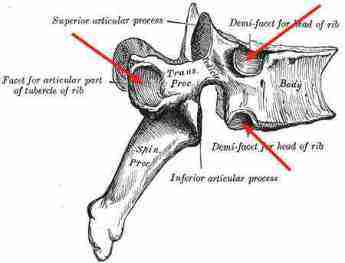
Notice the three arrowed facets where the rib head can be subluxated causing severe pain.
FROM THE COAL FACE : Iatrogenic Illness
The thoracic spine is usually not the source of serious problems. Irritating, and occasionally acute pain, but because of the stabilising ribs, it generally gives much less serious trouble than the neck and lower back. Consequently, it also less xrayed. Chiropractors generally, myself included will often adjust the thoracic spine without first having given it the attention that one might give the lumbar spine.
Mrs S is a woman of about thirty who had significant Low Back Pain since shortly after the birth of her first child, about three years ago.
Opinion has it that much low back pain starts during the last trimester, but in my experience it often starts soon AFTER the birth of the child. All the lifting, but sometimes within a month of falling pregnant.
The lower back pain didn't improve with various other medical ministrations, and six months the pain started radiating down her leg.
She has responded very well, and after a month her low back and leg pain is almost gone.
But I adjusted a subluxation between her shoulder blades, where she had no pain, and she is now really suffering. It's a little better, but she's not a happy lady. She came with one pain, and left with another.
That's what we call Iatrogenic Illness, or doctor caused disease.
Read more … IATROGENIC ILLNESS
UPDATE: Fortunately with the correct management of her rib the pain soon passed. My point? Rib pain can be caused by an overly zealous manipulation in the mid back.
For information about chiropractic treatment of rib pain, click here; RIB PAIN TREATMENT
Costosternal Anatomy - The Breast
The breast obviously lies just adjacent to the costo-sternal joints, and covers some of the muscles.
A breast condition may mimic the costo-sternal syndrome, and occasionally a breast examination by your chiropractor may be indicated. Alternatively, you could ask that your GP do the examination. Talk frankly about it.
During the treatment of the costo-chondral syndrome, the doctor's hands will approximate the breast tissue as s/he firmly adjusts the rib during the in or out phase of breathing. He should release his grip, and slightly remove his hands during the inactive phase of breathing, to ensure that there is no embarrassment.
Should you feel awkward then it may be necessary to ask a friend or family member to accompany you for breastbone pain treatment, or ask if the secretary may be present. It is best to talk frankly about it.
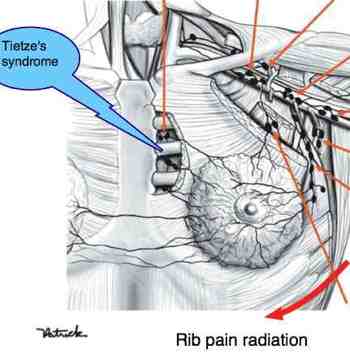
Nerves - costo sternal anatomy
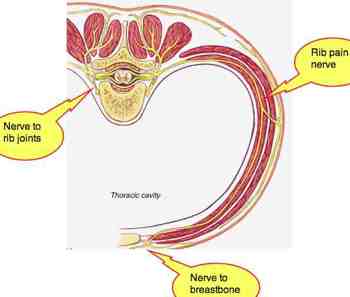
The NERVE bundles from the spine, are threaded between the muscle layers, and are responsible for the innervation of the intercostal muscles.
The pain often radiates along the length of the rib causing flank pain (under the armpit), chest pain mimicking a heart attack if it's on the left side and, if it involves the lower ribs on the right, gallbladder or liver conditions.
As can be seen the costosternal anatomy is unusual in both function and structure, making it vulnerable to various pain syndromes. Other conditions may mimic a rib problem. For example, should you also be experiencing indigestion, a hiatus hernia.
First thought though with indigestion should always be to drink first, and eat afterwards, especially at night, and avoid bread and rolls.
Second thought should be to start making your own kefir; it's an ancient Bulgarian drink, not unlike a very strong yoghurt. It is known as a probiotic and should you have a heliobacter infection, or other, the huge mass of friendly bacteria will help to overwhelm them.
On a personal note these kefir benefits cured a grumbling ulcer and small hiatus hernia that gave me great indigestion at night, in just one week; I still take it regularly.
Copy and paste 'kefir benefits' into the Site Search function in the navigation bar on your left.
Did you find this page useful? Then perhaps forward it to a suffering friend. Better still, Tweet or Face Book it.
MONTHLY NEWSLETTER. Signed up yet? It is free.
BACK ISSUES
Chiropractic Help Backissues ... our monthly newsletter, click here for all the old issues.
- Issue #53: No short cuts to better health / Simple balance and quad strengthening exercises
- Issue #52: Needs an adjustment / Everything must change
- Issue #51: Elective surgery in the elderly / Cooling and reheating starches
- Issue #50: Make time for breakfast / Scrambled eggs and parsley
- Issue #49: Consulting a locum / Green salad /Eggs Florentine
- Issue #48: Hips and the sacroiliac joints/ Bacon and eggs
- Issue #47: Life without medication/ Eight coloured foods
- Issue #46: Lower backs and ankles/ kaempferol and cancer prevention
- Issue #45: Tingling, weakness and malaise/ vitamin B1
- Issue #44: Applying general chiropractic principles to the hand / Omega-3
- Issue #43: Art and science of chiropractic / Kale
- Issue #42: Tum sleeping / Flaxseed
- Issue #41: Adult potty training / Beetroot constipation
- Issue #40: Ominous lumbar signs / Too much medication?
- Issue #39: Swapping chiropractors / Butter is back
- Issue #38: Making a correct diagnosis / Make your own pesto in five minutes.
- Issue #37: Have your wisdom teeth out in the chair
- Issue #06: Safety on the Stairs / Ginger
- Issue #05: Safety in the home / Red foods
- Issue #04: Whiplash and the Joints of Luschka / Parsley
- Issue #03: How to stop falling / Danger of a low fat diet
- Issue #01: Tingling in the arms and hands / Apples
(PS. If you find them irrelevant to your needs or an exercise in tedium, one click will UNsubscribe you.)
